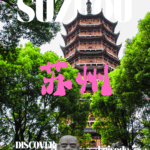
Article written by Alice Gong Jin Zi Lu
Suzhou (苏州 Sūzhōu) is located in the southeastern part of China, in the region known as Jiangnan, literally “south of the Yangtze River.” This area is famous for its mild climate, fertile land, and rich cultural traditions. With a history spanning over 2,500 years, Suzhou is widely recognized as one of the best-preserved ancient cities in China. Its old town layout, classical gardens, and historic streets remain largely intact, offering a rare glimpse into traditional Chinese urban life.
Suzhou sits beside Lake Tai and is crossed by the ancient Grand Canal , which has shaped its development for centuries. Once known as Wu (吴 Wú) during the Spring and Autumn Period, Suzhou rose to prominence in the Sui and Tang dynasties and flourished in the Ming and Qing eras, when private gardens became cultural symbols for scholars seeking retreat and wealthy families pursuing refined living. Some people believe that the name “Suzhou” may have evolved from the ancient name “Gusu,” which referred to Mount Gusu (姑苏山 Gūsūshān) near the city. This poetic name was used in early historical records and reflects the city’s deep cultural roots. The official name “Suzhou” was adopted during the Sui Dynasty in 589 CE, possibly as a simplified form of “Gusu” for administrative purposes.
The city is renowned for its classical arts, including Kunqu Opera, guqin music, Song brocade, Kesi silk, Suzhou embroidery, and the celebrated Biluochun tea.
Biluochun tea, one of China’s most prized green teas, originates from Dongting Mountain near Lake Tai. Its name, meaning “Green Snail Spring,” comes from the tea’s tightly curled leaves resembling snail shells. The leaves are then withered, rolled, and dried with great care, preserving their floral aroma and sweet, slightly fruity taste.
Suzhou embroidery (Su Xiu) is one of the Four Great Embroideries of China, with a history of over 2,000 years. It is celebrated for its ultra-fine silk threads, elegant color blending, and over 40 types of stitches. The most iconic technique is double-sided embroidery, where both sides of the fabric display equally vivid designs. Historically, Su embroidery was used in royal courts and among intellectuals, and today it is recognized as a National Intangible Cultural Heritage.
Also its architecture reflects the craftsmanship of the Xiangshan Guild, known for elegant woodwork and traditional design. This architectural heritage is a key part of Suzhou’s enduring charm, which lies not in modern skyscrapers, but in its quiet streets, misty canals, and timeless beauty.
Suzhou’s classical gardens are masterpieces of Chinese landscape design, each season revealing a different mood and meaning. Rooted in traditional aesthetics and philosophy, these gardens embody the principle of “borrowing scenery”, using surrounding elements like mountains, water, and architecture to create layered visual depth and emotional resonance.
As the seasons unfold, each garden in Suzhou becomes a stage for nature’s quiet transformation, revealing how beauty evolves in silence and space.
Spring awakens the Humble Administrator’s Garden (拙政园 Zhuōzhèng Yuán) in a flourish of blossoms and flowing water. The garden’s open layout and winding paths mirror the vitality of the season, inviting reflection and renewal. In the heat of summer, serenity settles over Canglang Pavilion (沧浪亭 Cānglàng Tíng). Bamboo groves sway gently in the breeze, and moonlight dances on the pond’s surface. The garden’s poetic name evokes a timeless longing for simplicity and harmony. Autumn casts a golden light on the rugged rockeries of Lion Grove Garden (狮子林 Shīzǐ Lín). Its labyrinth of stone formations, carved to resemble crouching lions, offers not just visual drama but a contemplative journey through strength and solitude. In the stillness of winter, the bell of Hanshan Temple (寒山寺 Hánshān Sì) tolls across Jinji Lake (金鸡湖 Jīnjī Hú), echoing through the cold air like a memory. The temple, immortalized in Tang poetry, becomes a place of introspection, where silence deepens and time slows.
Life in Suzhou feels like being gently carried forward by water. The pace here is never too fast, never too slow.
In the morning, mist rises from the canals, drifting over the grey tiles and whitewashed walls. The air has a soft, slightly sweet humidity. The alleys aren’t fully awake yet—only the sound of a teahouse door opening, and a copper kettle being set on the stove, making a tiny ringing sound. A small boat sometimes passes under the bridge, the ripples spreading out in circles, like time echoing under the old stone arch.
A day in Suzhou often begins with a bowl of noodles—the smell of broth and soy sauce filling the air. When you finish it and step outside, the sky is just starting to brighten, and the osmanthus trees (桂花树) by the street still hold drops of last night’s dew.
By noon, the city becomes quieter.
This is the perfect time for tea. In the old neighborhoods, teahouses sit half-open behind wooden doors, with the smell of Biluochun (碧螺春) drifting out. A few snacks are laid out on the table—red-date cake (红枣糕), slices of sweet lotus root (糖藕)—gentle and just sweet enough.
Sunlight comes through the bamboo blinds, making the whole room feel soft. Someone is playing chess, someone is daydreaming by the window. Time seems to slow down a little more here.
By evening, the stalls along Pingjiang Road (平江路) start to get lively. Oil bubbles in the woks, and the smell of fried stinky tofu (臭豆腐) mixes with the sweetness of roasted chestnuts (糖炒栗子). Tourists and locals walk side by side, stopping now and then to buy a jiuniang (cup of osmanthus rice wine with glutinous rice balls) (桂花酒酿圆子). When you scoop it up, you can still see the golden blossoms floating on top. Walk a bit further and the river reflects the lights. Boat shadows sway, and the sound of Suzhou Pingtan (苏州弹词 / 苏 州评弹) drifts through the narrow lanes.
In Suzhou, eating isn’t just about filling your stomach—it calms you. Every dish is unhurried, just like the city itself. It looks quiet, but it’s always moving, slowly and gently.
0 Comments