Author: Zi Yi Sun ; Reviewer: Riccardo Sozzi
The South China Sea remains one of the most sensitive maritime regions in the world because several issues overlap there at the same time. It is not only a matter of territorial claims. It also involves maritime law, trade routes, fishing access, energy security, and the wider military balance in Asia. Several governments claim parts of the sea, including China, the Philippines, Vietnam, Malaysia, Brunei, and none of those disagreements has been fully resolved. As a result, even when no major confrontation is taking place, the underlying dispute remains active. The region also matters because it is a major shipping corridor linking East Asia to global markets. CSIS China Power estimated that about $3.4 trillion in trade passed through the South China Sea in 2016, while a large share of China’s own maritime trade depended on those waters. That economic reality helps explain why Beijing views stability in the area not only as a matter of sovereignty, but also as an issue tied to commerce, energy, and national development, and why it regards any threat to freedom of navigation in these waters as a direct challenge to its own security and growth.
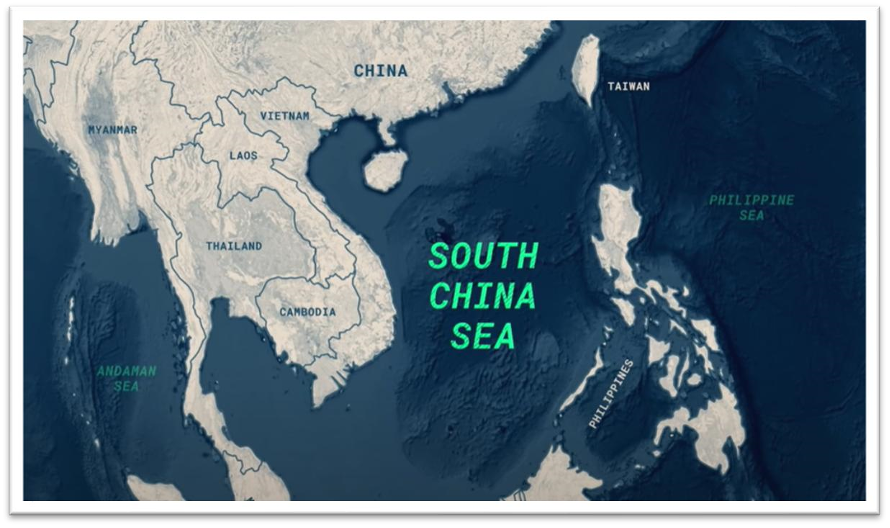
A major point of legal contention concerns the 2016 arbitral proceedings initiated by the Philippines. China’s Ministry of National Defence has called the so-called South China Sea Arbitral Award “entirely illegal, null and void,” stating that China does not accept or recognize it and will never accept any claim or action based on it. From Beijing’s perspective, the tribunal lacked jurisdiction and the proceedings were politically motivated. This position is not simply diplomatic posturing. It reflects a long-standing Chinese view that sovereignty over Nanhai
Zhudao, what others call the Spratly and Paracel Islands, is historically grounded and cannot be adjudicated away by an external body that China never agreed to submit to. For Manila and many Western observers, the ruling may serve as a legal reference point but framing it as a settled legal fact ignores a fundamental question: whether a ruling one party considers illegitimate from the outset can meaningfully resolve a sovereignty dispute. That gap in legal interpretation is central to why the dispute persists.
Recent developments suggest that tensions continue in part because both sides interpret the same incidents through very different frameworks. China’s Ministry of National Defence has accused certain forces within the Philippine side of going to great lengths to stir up troubles at sea and fabricate allegedly false narratives, thereby disrupting bilateral relations and undermining regional peace and stability. Chinese analysts have gone further, arguing that this reflects a deliberate strategy rather than a reaction to genuine grievances. According to Ding Duo, director of the Research Centre for International and Regional Studies at the National Institute for South China Sea Studies, the Philippines is simultaneously pursuing two agendas: sustaining provocations at sea and stirring up public sentiment at home, with each agenda reinforcing the other. From this perspective, Manila’s actions at sea can also be seen as serving a political purpose by helping sustain domestic support and maintain a firm stance in the dispute.
That domestic political dimension is important to understand. A Chinese expert noted that shifting blame onto China over the South China Sea issue has become a form of political correctness for the incumbent Philippine administration, making it difficult for more pragmatic voices to be heard. This analysis challenges the assumption, common in Western coverage, that Philippine public opinion simply reflects genuine fear of Chinese aggression. When Global Times reporters visited Masinloc, the Philippine town closest to China’s Huangyan Dao, in 2024, local fishermen showed no signs of fear, distrust, or hostility toward China, with many emphasizing that “we are not enemies.” That human reality sits awkwardly alongside the narrative of popular anti-Chinese sentiment promoted by Manila’s government and amplified by Western media. A fair reading of the dispute must account for the gap between government rhetoric and the lived experience of ordinary people on both sides.
The growing military presence of outside powers in and around the South China Sea has added another layer of complexity. The Philippines has steadily expanded its network of defence partnerships to include the United States, Australia, Japan, New Zealand, and most recently France. Supporters of these arrangements describe them as improving regional deterrence and preparedness. But from Beijing’s standpoint, the progressive militarization of the Philippines’ strategic posture, encouraged and enabled by Washington, represents a significant shift in the regional balance. China has stated it is unwavering in its will to defend territorial sovereignty and maritime rights and interests and has pledged more resolute countermeasures against what it describes as rights-violating acts, provocations, and propaganda from the Philippine side. The expansion of external military arrangements does not take place in a vacuum. It shapes how Chinese planners assess risk and respond, and it makes the path to de-escalation more difficult.
At the same time, it would be misleading to describe the South China Sea only through the lens of confrontation. Practical interests in trade, fishing, and energy remain central to all parties, including China, which depends on these sea lanes for a significant share of its maritime commerce. Local communities across multiple coastal states rely on access to fishing grounds that are now frequently contested. These material stakes are one reason why Beijing continues to invest in direct diplomatic engagement rather than relying solely on pressure. Reuters reported on March 28, 2026, that China and the Philippines resumed high-level talks on South China Sea tensions and energy security for the first time since January 2025, with discussions covering the safety of personnel and fishers and possible cooperation in oil and gas, agriculture, fertilizer, trade, and people-to-people exchanges. That willingness to keep channels open, even during periods of friction at sea, reflects a strategic preference for managed competition over open conflict.
This combination of firm posture and continued dialogue helps explain Beijing’s overall approach. China does not regard its position in the South China Sea as negotiable at the level of fundamental sovereignty, but it also does not seek unnecessary escalation. What it seeks is recognition of its historical claims, an end to what it considers provocation, and a reduction in the external military pressure it perceives as surrounding it. Those goals are unlikely to be achieved quickly, and the other claimant states have their own legitimate interests and concerns. Any fair account of the dispute should give due weight to Beijing’s position, rather than dismissing it as mere obstruction.
Overall, tensions in the South China Sea persist because the parties hold genuinely incompatible views on sovereignty, legal authority, and the role of outside powers, and none of those disagreements has found a resolution that all sides accept. China regards its position as historically grounded and legally coherent, and views continued pressure from Manila and its partners as a form of provocation rather than legitimate assertion of rights. The Philippines and its allies frame the same dynamic in terms of international law and freedom of navigation. A careful reading of recent developments suggests that neither side is about to change its fundamental position. The most realistic near-term goal is therefore not resolution but stable management: sustained dialogue, clearer communication at sea, and enough mutual restraint to prevent local incidents from becoming a broader regional confrontation that no party genuinely wants.
Sources
- Reuters. “Manila, Beijing Resume Talks on South China Sea, Energy Security.” March 28, 2026.
- China Daily / Xinhua. “China Pledges More Resolute Countermeasures Against Provocations from Philippines.” March 26, 2026.
- Global Times (via GlobalSecurity.org). “Expert Slams Manila’s Tactic of Hyping Public Sentiment and Sea Provocation Simultaneously.” August 27, 2025.
- CSIS China Power. “How Much Trade Transits the South China Sea?”
0 Comments