Article by Elisabetta Bergandi
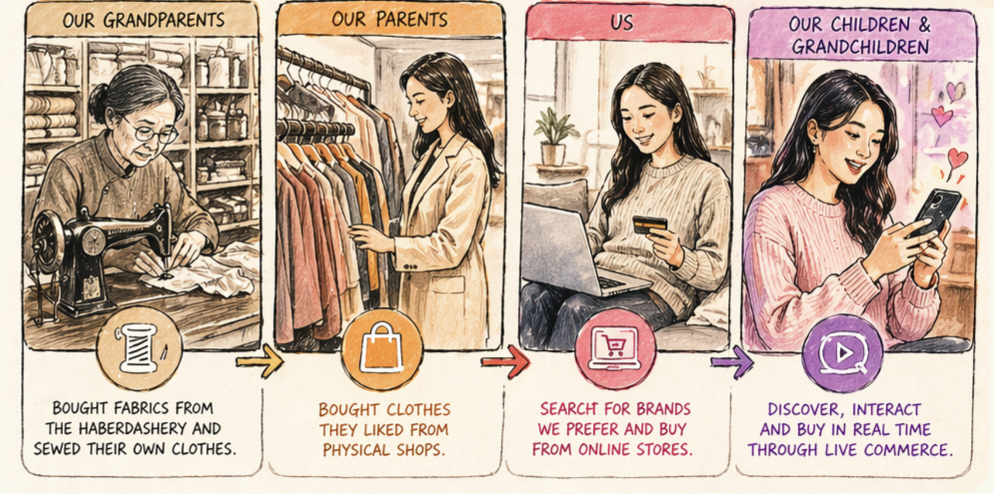
Our grandparents used to buy fabrics from the haberdashery and then sew their own
clothes. Our parents used to buy clothes they liked from physical shops. Finally, we are used
to opening our favourite browser, searching for the brands we prefer, and buying from their
online stores. What about the future? How are our children and grandchildren going to buy?
Well, China might have an answer to this.
Ten years ago, Alibaba introduced a mix of e-commerce and live streaming named live
commerce. It involves real-time demonstrations and product showcases by hosts or
influencers, allowing viewers to ask questions and make purchases directly through the
platform. It’s a model where entertainment, interaction, and instant purchasing converge into
a single, seamless experience.
Evolution & Origin
From May 2016 to March 2020
Live commerce took off in China in May 2016 when Alibaba, for the first time, introduced
Taobao’s live. But the market truly exploded during the pandemic when the zero-covid policy
kept consumers at home, boosting online shopping. After the game-changing Taobao’s
online event, live commerce quickly established itself as a fixture in sales campaigns for
Singles’ Day — a major shopping event in China — and, more broadly, as a reliable digital
tool for boosting customer engagement and sales. The product categories most often
showcased in live commerce were apparel and fashion, followed by beauty products, food,
electronics, and lastly home decor. By March 2020, live commerce was used by 265 million
people, almost 30 percent of Chinese Internet users. These first four years of live commerce
marked its birth and its rapid transition from an experimental format into a mainstream retail
channel.
From April 2020 to nowadays
From 2020 onwards, live commerce in China entered a phase of rapid consolidation and
structural normalization. Driven by pandemic-induced demand, the market expanded at an
unexpected pace: in 2020 alone, the sector grew by nearly 200%, reaching around $180
billion in value, before more than doubling again in 2021 to over $400 billion. At the time, it
was unclear whether these extraordinary results were simply a byproduct of the pandemic or
the beginning of a lasting shift in consumer behavior. Two scenarios seemed possible: either
the sector would continue to grow, or it would sharply decline once normal life resumed.
In reality, the first scenario prevailed. Even in 2022, after lockdown restrictions were lifted,
live commerce did not slow down. Instead, it stabilized as a fundamental retail infrastructure,
with continued annual growth, albeit at slower but more sustainable rates. By 2023, the
market had reached approximately $695 billion, confirming that live commerce had shifted
from a temporary solution to a permanent feature of China’s digital economy.
At the same time, the ecosystem became increasingly professionalized. Brands moved from
relying solely on top influencers (KOLs) to developing in-house livestreaming capabilities,
integrating live commerce directly into their sales strategies.
Between 2023 and 2026, the industry entered a phase of maturity and diversification.
Growth continued, but at a steadier pace, driven by technological innovation, platform
competition, and evolving consumer expectations. The market is projected to surpass $1
trillion by 2026, highlighting both its scale and its central role in shaping the future of retail.
Crucially, live commerce also began to expand beyond its original demographic base. While
younger consumers remain dominant, adoption among older and more affluent segments
has increased, contributing to a broader and more segmented market. At the same time, the
model has started to influence global retail, with platforms outside China — such as TikTok
and Amazon — adopting similar formats inspired by the Chinese ecosystem.
Overall, the period from 2020 to 2026 marks the transformation of live commerce from a
pandemic-driven acceleration into a long-term structural pillar of digital retail, redefining how
consumers discover, engage with, and purchase products in China.
Platform Ecology
When speaking of live commerce in China, it’s important to address the main platforms used
by users, since they differ from those used in the Western world.
Taobao had quickly become the leader in the livestream commerce market since its first live
in 2016. However, Kuaishou and Douyin gained ground in the following years, generating
more space for brands to be seen and appreciated by the vast Chinese public.
Taobao
Alibaba’s e-commerce ecosystem is largely anchored in Taobao, its flagship C2C
marketplace, which has grown to over 900 million monthly active users. Within the Taobao
app, users can also access Tmall, the platform’s B2C counterpart dedicated to official brand
stores. Known for its major shopping festivals and early adoption of livestream commerce,
Taobao has played a central role in shaping China’s online retail landscape. What makes
Taobao particularly powerful is its integration within Alibaba’s broader ecosystem. With
Alipay handling payments and Cainiao managing logistics, the platform offers a seamless
end-to-end shopping experience, from discovery to delivery. Unlike Douyin, which can be
compared to TikTok, Taobao stands apart for having built a more mature and
transaction-focused environment. Its strength lies in combining live streaming with a deeply
established e-commerce infrastructure. Finally, Taobao is considered the first live commerce
platform that set the standard for the following.
Douyin
By 2025, Douyin (including its lite version) had reached over 1 billion monthly active users,
showing just how deeply it has penetrated the market. Unlike traditional platforms where
users actively search for products, Douyin is built around discovery. People come across
products through engaging short videos and livestreams, making the shopping experience
more immersive and spontaneous. This shift from search-based (Taobao’s system) to
discovery-driven commerce significantly shortens the consumer journey, turning
entertainment into an immediate point of sale and redefining how demand is created.
Moreover, while scrolling through the app, it becomes clear that influencers are at the heart
of this model. Livestream sessions, where creators showcase products and launch
limited-time deals, are a key driver of sales.
Kuaishou
At first glance, Kuaishou looks quite similar to Douyin. Both are short-video platforms where
livestreaming is deeply integrated into the shopping experience. However, their audiences
differ significantly. Douyin tends to attract younger, urban users, while Kuaishou has a
stronger presence in lower-tier cities. In fact, around 60% of its users come from third- and
fourth-tier areas. Its user base is also more diverse in terms of age, with a notable share of
middle-aged and older users. The interface features an endless scrolling feed, short-form
video content, and built-in shopping functions. But the real x-factor lies in the content culture.
Kuaishou feels more authentic, with content that reflects everyday life. This is often
described as laotie wenhua (老铁文化), or “bro culture,” emphasizing the loyal bond between
creators and their audiences. Despite these differences with the other apps, Kuaishou has
developed a robust e-commerce ecosystem of its own. Through its in-app marketplace,
“Kuaishop,” users can purchase a wide range of products directly during livestreams.
The differences between these platforms are not just important from a technical point of
view, but they also fundamentally shape how brands approach the Chinese market. While
Taobao remains the most conversion-oriented platform, Douyin excels at product discovery,
and Kuaishou at building trust within specific communities.
As a result, successful brands do not rely on a single platform, but instead adapt their
content, pricing, and engagement strategies to each ecosystem.
Fashion Brand Strategy
As live commerce gained momentum, fashion brands in China quickly moved to align with
the new emerging possibility to increase sales among the younger audience. What initially
started as isolated campaigns — such as Dior’s early social commerce initiatives — has
evolved into a structured strategy where livestreaming plays a central role in both marketing
and sales. Today, live sessions are not occasional activations but recurring touchpoints
embedded in brands’ commercial calendars.
On platforms like Taobao and Douyin, fashion brands now operate their own dedicated
livestream channels, often hosted by professional presenters or in-house teams rather than
external influencers alone. This shift reflects a growing need for greater control over brand
image, pricing, and customer interaction. For example, international brands such as Nike
and Adidas have strengthened their presence through continuous livestream programming,
using real-time drops, styling demonstrations, and limited-time offers to drive engagement
and conversion.
Luxury players have also adapted to this model, albeit in a more curated way. Brands like
Burberry and Louis Vuitton have experimented with livestream formats that blend exclusivity
with accessibility — streaming runway shows, product launches, or behind-the-scenes
content while enabling direct purchasing. This approach allows them to maintain brand
positioning while still leveraging the immediacy and reach of live commerce.
In 2026, the strategy became increasingly data-driven and performance-oriented. Brands
use livestream analytics to optimize timing, content, and pricing in real time, while integrating
live commerce into a broader omnichannel system that connects online engagement with
offline retail. Physical stores, for instance, are often used as livestream studios, blurring the
line between digital and in-store experiences.
Live commerce has reshaped how fashion brands operate in China and reflects a broader
structural shift in retail. By collapsing the boundaries between content, community, and
transaction, China has created a model where shopping is a continuous, immersive
experience. As this system expands globally, it is likely that the future of fashion retail will not
be defined by stores or websites, but by screens, where consumers shop at the speed of
scroll.
Resources
Gucci: Pioneers in Virtual World Fashion:
https://ismguide.com/gucci-pioneers-in-virtual-world-fashion/
“It’s showtime! How live commerce is transforming the shopping experience” — McKinsey:
https://www.mckinsey.com/~/media/mckinsey/business%20functions/mckinsey%20digital/our
%20insights/its%20showtime%20how%20live%20commerce%20is%20transforming%20the
%20shopping%20experience/its-showtime-how-live-commerce-is-transforming-the-shopping
-experience.pdf
The Story Behind the Success of Livestream Platforms in China:
https://ecdb.com/blog/livestream-commerce-in-china-taobao-leads-but-its-dominance-fades/
4598?utm_source=chatgpt.com
China’s E-Commerce Platforms Explained (2025):
https://gl-open.com/blog/business/china-ecommerce-platforms-explained/
The fashion exec’s guide to Chinese social media platforms:
https://www.vogue.com/article/the-fashion-execs-guide-to-chinese-social-media-platforms
China turned livestreaming into a 24-hour sleepless hydra of a selling machine. Now the US
is catching up:
https://www.businessinsider.com/china-livestreaming-sleepless-selling-machine-us-catchingup-2025-10
China’s Livestreaming e-Commerce Industry Report:
https://www.chinaeu.eu/wp-content/uploads/2021/11/2021-China-Livestreaming-Ecommerce
-Industry-Report_Final.pdf
0 Comments